









In the history of modern Punjab, few administrators have left a legacy as deep and wide as M. S. Randhawa. Often called Punjab’s “Sixth River,” his contributions extended far beyond governance. He played a defining role in rebuilding a shattered region after Partition, shaping the identity of Chandigarh, strengthening agricultural education, and preserving Punjabi art and culture.
Born in Punjab in 1909, Randhawa belonged to a generation that witnessed colonial rule, the struggle for independence, and the massive transformation of India after 1947. After joining the Indian Civil Service, he quickly earned recognition for his discipline, administrative clarity, and people-oriented approach. But it was during the most turbulent period in Punjab’s history—the Partition of India—that his leadership truly came into focus.
The Partition of 1947 led to one of the largest human migrations in history. Millions were displaced, villages were destroyed, and entire communities were forced to rebuild their lives from scratch. Punjab, being at the center of this upheaval, faced immense challenges. Randhawa was among the officers tasked with managing rehabilitation efforts. He worked closely with displaced families, helped coordinate relief measures, and supported the restoration of basic stability in affected regions. His role during this crisis reflected not just administrative responsibility but also deep empathy for human suffering.
Once immediate relief efforts were stabilized, Randhawa shifted his attention to long-term development. One of his most significant contributions came when Chandigarh was being planned as the new capital of Punjab after Partition. While Swiss-French architect Le Corbusier is widely recognized for designing the city’s modernist structure, Randhawa ensured that Chandigarh would not become only a concrete city. He strongly believed that urban development should integrate nature, culture, and livability.
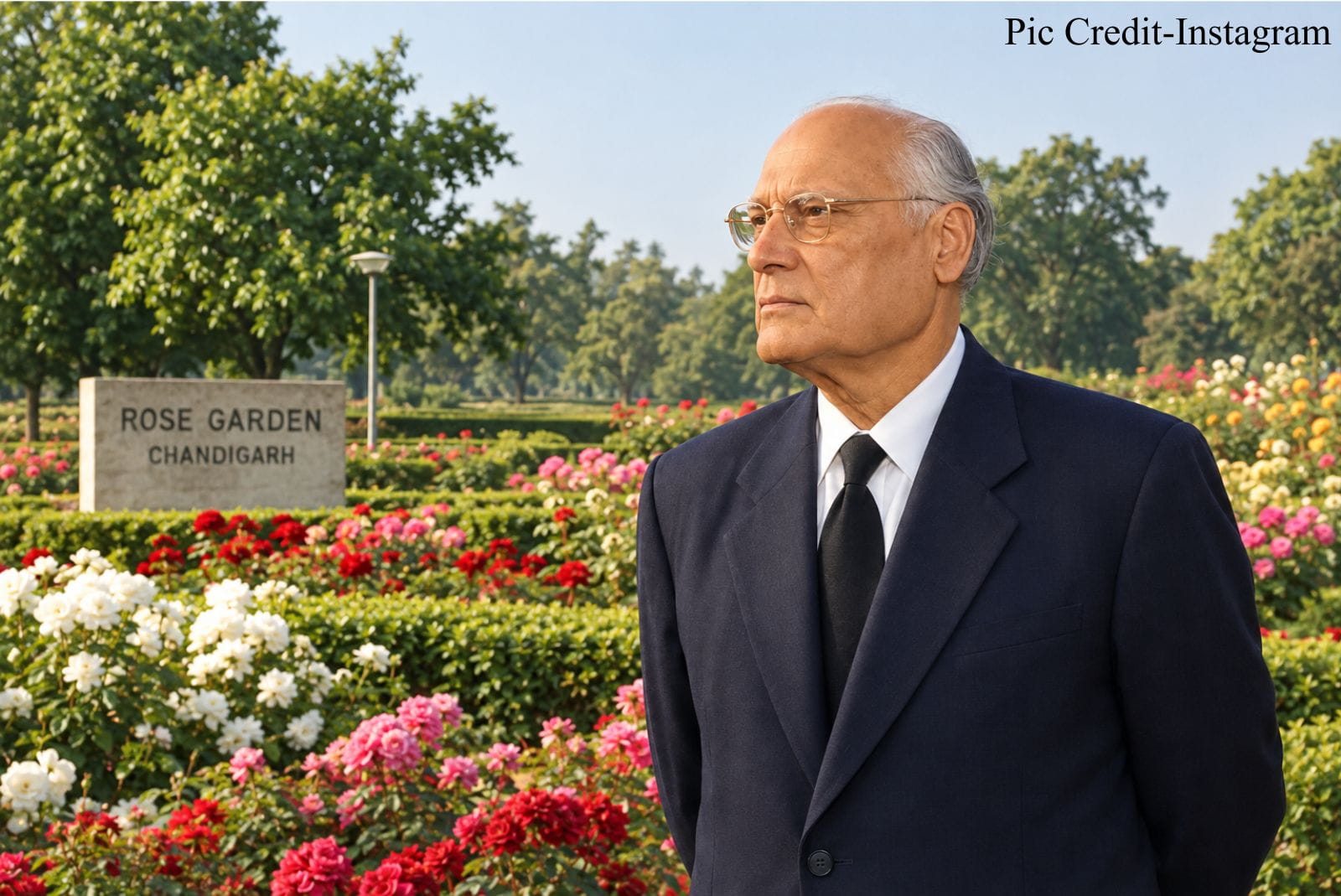
As the first Chief Commissioner of Chandigarh, he actively promoted large-scale plantation drives, landscaped gardens, and green belts. His vision helped transform Chandigarh into one of India’s greenest and most well-planned cities. The famous Zakir Hussain Rose Garden, home to thousands of varieties of roses, is often associated with his efforts to bring ecological balance and aesthetic beauty into urban planning. Because of such initiatives, Chandigarh is still known today for its tree-lined roads, open spaces, and environmental harmony.
Beyond urban development, Randhawa made equally important contributions in the field of agriculture. He served as the Vice Chancellor of Punjab Agricultural University, an institution that later became a cornerstone of India’s Green Revolution. At a time when India was struggling with food shortages and low agricultural productivity, the university played a critical role in developing high-yield crop varieties, modern farming techniques, and scientific agricultural education.
Randhawa understood that India’s future depended heavily on strengthening rural economies and empowering farmers with knowledge. Under his leadership, the university became a center for innovation and research, helping Punjab emerge as one of the most productive agricultural regions in the country. His efforts indirectly contributed to food security across India during a critical phase of national development.
However, his influence was not limited to administration and agriculture. M. S. Randhawa was also a scholar deeply invested in preserving Punjabi culture, literature, and art. He wrote extensively on the history of Punjab, its folk traditions, and its cultural identity. Through his writings and documentation, he ensured that many aspects of Punjab’s heritage were recorded and preserved for future generations.
He also supported artists and encouraged cultural institutions, believing that development was incomplete without preserving a society’s artistic and historical roots. His work reflected a rare combination of administrative efficiency and cultural sensitivity.
Because of his wide-ranging contributions, many scholars and historians refer to him as Punjab’s “Sixth River.” The metaphor is powerful—Punjab is traditionally known as the land of five rivers, but Randhawa’s influence is seen as an additional force that nourished the state in multiple dimensions. From rehabilitation after Partition to environmental planning in Chandigarh, from agricultural transformation to cultural preservation, his impact flowed through every major aspect of Punjab’s development.
Even decades after his time, his legacy continues to shape the state. Chandigarh remains one of India’s most admired planned cities. Punjab Agricultural University continues to drive agricultural innovation. His writings still serve as valuable records of Punjabi culture and history.
The story of M. S. Randhawa is a reminder that true leadership is not defined by visibility but by lasting impact. While many administrators are remembered for policies or positions, Randhawa is remembered for shaping the physical, agricultural, and cultural landscape of an entire region.
His life demonstrates that nation-building is not a single act but a continuous process that involves empathy, vision, and commitment across multiple fields. From rebuilding lives after one of history’s greatest tragedies to designing a greener future for generations, his contributions continue to flow through Punjab like an unseen river—steady, life-giving, and enduring.